Showing posts with label Research. Show all posts

Friday, May 23, 2025

Never Underestimate a Library


Genealogical research can certainly be done from your home. There are many websites with information. However, do not overlook libraries. I have traveled to marvelous state, county and town libraries in the areas where my ancestors lived. Those libraries are filled with treasures for genealogists.


I live in New York State, near our Capital. Over the years that I researched my book, ‘Our Brown Roots,’ I traveled west to Ohio and south to Virginia, North Carolina, South Carolina, Mississippi and Louisiana. I visited archives, town halls, cemeteries and libraries. I met friendly, helpful people and learned something new at every location.

Do you think everything is digitized? No. Small rural libraries that stand in the town where your ancestor farmed may have unique reference materials that are not available online. Those libraries often contain local histories that can teach you how people lived when your ancestor was working and raising a family.


  • In the Fairfax Regional Library, VA I learned that John Hollis, my 7th great grandfather, was in the French & Indian War, serving under Col. George Washington.
  • In the Hudson Area Library, NY I found school yearbooks for my father and his siblings with photographs of their young faces.
  • In Washington Parish Library, LA I found a binder of obituaries. They had been clipped from local newspapers, alphabetized and photocopied. Names from 3 of my family branches were included. These are not on Newspapers.com.


Those are just 3 examples of libraries and discoveries. While visiting those libraries I also went to the cemeteries and town halls. I walked around in the towns where my ancestors lived.

Now that ‘Our Brown Roots’ is in print I am beginning to write letters to those libraries. In my letters I recognize the many resources available in those libraries. I thank “all of you who provide historical and genealogical resources to your patrons.”

With my letters I am sending those libraries a copy of my book. Since those libraries stand where my family lived/lives I am hoping my book will help others to learn about our shared family.

These are some of the Libraries I have visited & am writing to

 [with links to my blog posts]:


Hudson Area Library

51 North 5th Street

Hudson, NY 12534


Fairfax Regional Library

Virginia Room

10360 North Street

Fairfax, Virginia 22030


Charlotte Mecklenburg Library

Founders Hall Library

100 North Tryon Street

Suite 290

Charlotte, NC 28202


York County Library

138 East Black Street

Rock Hill, SC 29730


Orangeburg County Library

1645 Russell Street

Orangeburg, SC 29115


Lancaster County Library

313 South White Street

Lancaster, SC 29720


Pike – Amite – Walthall Library System

1022 Virginia Avenue

McComb, MS 39648


Washington Parish Library

825 Free Street

Franklinton, LA 70438


The York County Library in SC sent me this nice note when they received my book:


Your wonderful book "Our Brown Roots" arrived at our library this week.  Thank you very much for your kind donation to our collection and I'm very pleased we were able to help you with your research. Congratulations on completing such a nice study on your families!  I will get the book cataloged and added to our collection for other researchers to enjoy. Best wishes to you as you continue your genealogical journey!
Thanks again, John Skardon


You can contact Troy Book Makers for a copy.


Wednesday, January 1, 2025

New Year Resolution: Done!

 For many years my New Year's Resolution remained unchanged:

-- Finish writing my Book about my paternal grandfather's family. --

I kept thinking that this would be the year to finish. I would set aside research and focus on writing what I have learned. Finally I made it happen.


Stop Researching & Write!

I had written my book in sections, each a surname was a branch of my paternal grandfather's ancestors. I had researched each branch for many years. If I was to ever share that information with my family I had to put the brakes on research and focus on writing.


Pull it all Together!

For each section I:

  • polished off the writing 
  • added photos, charts & maps
  • added documents, newspaper articles, wills & estate papers
  • added timelines 
  • edited, edited & edited
Format!

Then, I set up a format for the book and brought all the sections together.

To the main body of the book I added:

  • Table of Contents
  • Introduction
  • How to Navigate This Book
  • List of Photographs
  • A brief History of each State where my ancestors lived
  • Epilogue
  • About the Author
  • Endnotes [Without references it is only a story!]
  • Index [I feel this is critical for readers!]
Seek Help!

When I came up to a brick wall of writing I sought help. I found it difficult to see my errors. I had read it all many times and that made it difficult to see it objectively. I double checked some stories with my aunts. I reached out to my cousin, Nancy, to find my typos, check my formats and generally give me advice. 

Then I contacted the Troy Book Makers, my publishers. They helped me with troublesome page numbers, mysterious random blank pages, and other formatting issues. There were fees for that help but without it the book would not look professional.

Printing & Waiting!

Once I turned in the final digital copy of the book I had to learn patience. I felt a bit lost without the project at my fingertips. I could focus on other things but mainly, I waited.

DONE!

My book arrived in several heavy boxes. I cut through the tape, pulled out and held my book in my hands. Amazing!
Now I am sharing with my brothers, my aunts, my cousins, ...
You can do it too. No more dreaming. You can make it happen.
Make your resolution come true this year!

Do you want to learn more about the Browns?


Friday, August 11, 2023

Book Report: Deacons’ Accounts 1652 – 1674 Beverwijck/Albany


In researching various branches of my family I have to travel or reach out to places far from my house. However, when I learned more about our  Fortenberry/Van Valkenberg family the search came closer and closer to home. I only have to drive across the nearby Hudson River to go to the one time home of my 9th great grandfather, Lambert Jochemse Van Valkenberg.


Growing up in the Hudson River Valley of New York I have known that we were settled by the Dutch. New York was New Netherland. Albany was Fort Orange with the village of Beverwijck surrounding it. I have been excited to learn my family was a part of those early days. 


Deacons’ Accounts 1652 – 1674 Beverwijck/Albany


Janny Venema,

Translator & Editor


Picton Press, 1998


This book is a “translation of the account books, which were kept between 1652 and 1674 by the deacons of the Dutch Reformed Church, Albany’s oldest church.” 


Contents


Acknowledgements

Introduction

Glossary

Key to Abbreviations

Deacons’ Accounts

Bibliography

Index


In 1930 a small folio of 250 pages was found in the Dutch Reformed Church, the oldest church in Albany, NY. It was “bound in vellum with buckskin thongs.” This book is a transcript of that precious folio. 


The Dutch Reformed Church had a “consistory, consisting of a minister, elders and deacons.” (p ix) The deacons’ records show the church took care of the people in many ways. The poor were given medical care. Money was given for education of poor children. Needy people were boarded out or their rent was paid. There were provisions for coffins and funerals. Food and clothing was distributed. In April 1660 my ancestor, Lambert, was given “some bacon and meat.” (p 71) In November of that year he was given a blanket. (p 77) In June 1661 he was given “one schepel of corn.” (p 85) He continued with hard times. In December 1664 Lambert was given a pair of shoes and his wife was given 5 pounds of butter. (p 119) His name is included in these records until 1669.


Lambert Jochemse Van Valkenberg

c 1616 Netherlands – c 1685 NY

Son of Lambert Jochemse Van Valkenberg


My copy of this book has many bright colored sticky notes for book marks. I have scribbled in the margins and rejoiced over the discoveries. I am very grateful for the discovery of that ancient folio in 1930.


Related Posts:


Tuesday, June 20, 2023

Book Report: Edgecombe County, Along the Tar River

Is your family from Edgecombe County, NC? Would you like to learn about the place they lived? I do and that is what prompted me to purchase this book. It has taught me many things.

I drove over the Tar River recently from our home in New York State to to a family vacation on Hilton Head, SC. There was no opportunity to stop but I hope to return.


Three sons of James Alford [my 6th great – grandfather], Lodwick Alford, Goodrich Alford and Julius Alford, lived in Edgecombe County in the mid 1700s. The brothers all owned land there.


The earliest place I can locate my Brown family is in Edgecombe County, NC. My 5th great grandfather, Edward Brown lived there. He and the Alford family were there about the same time. 


This book helped me learn about the area they called home.


Edgecombe County, Along the Tar River


By Monika S. Fleming

The Making of America Series

Arcadia Publishing

Charleston, 2003


“Edgecombe County is located in northeastern North Carolina on the western edge of the coastal plain. It is about 75 miles east of Raleigh and just over 110 miles from the Atlantic Ocean. It is one of the state’s earliest settlements and has a rich agricultural history that expanded into industry in th elate nineteenth century, as the region was rebuilding after the Civil War. The county also has been home tostate and national leaders in the military and politics, and has produced several acclaimed artists and writers. While some individuals stand out, most residents are average people whose lifestyles nonetheless produce the interesting community that is the story of this book."


Contents


Life Along the River in the Eighteenth Century

The Antebellum Years of Growth and Prosperity: 1800 – 1860

War and Recovery: 1860 – 1880

Progress and Change: 1880 – 1920

Growing Pains: 1920 – 1960

Social, Educational, and Industrial Change: 1960 – 1990

Economic Turmoil and Natural Disaster: 1990 – 2000

Bibliography

Index


The Royal Governor Burrington created Edgecombe Precinct in 1732 and the Tar River appears on a map in 1733. Native Americans who lived there included the Tuscarora tribe that camped along the river. The first settlers, many who had traveled south from Virginia, lived along waterways. 


The book includes maps, photographs of prominent people, historic buildings, road signs, documents and more. It includes information on history, politics, geographical changes, wars and battles. Prominent families are mentioned.


Is Edgecombe County the home of your family? Give this book a read.


Monday, May 8, 2023

Book Report: North and South Carolina Marriage Records

Were your families living in Colonial North or South Carolina? Several of my family lines traveled, over the years, from Virginia through the Carolinas and settled in Mississippi or Louisiana. Some family members stayed in the Carolinas as the others moved further south. I have found some of their  marriages in this book.


North and South Carolina Marriage Records

From the earliest Colonial Days to the Civil War


By William Montgomery Clemens

Published by Genealogical Publishing Co., Inc.

Originally Published 1927


“The records of churches, parishes and court houses have been carefully examined for the data contained in this volume, and naturally through the long periods of war and rebellions, many of these have been lost and destroyed.”


This book is a testament to thorough and exacting research through early records. It is not a beautiful book with photographs and charts. More importantly, it is well researched and bursting with information. 


These are a few of my family’s marriages I found in this book:


  • OTH, Casper and Mary Stehely, 1752, Orangeburg Co., S. C.
  • OTT, Esther and John Heller, 1752, Orangeburg Co., S. C.
  • OTT, Jacob and Margaret Fichtner, 3 December 1754, Orangeburg Co., S. C.


Those will give you an idea of the information you can find in this book. I suggest you visit your favorite library and find a copy. The surnames are listed alphabetically. Thumb through and see who you can find. 


Do you have a favorite book about North or South Carolina?

Share it in the comments.


MY LIBRARY

At the top of this blog, click on My Library for many more books that I have found useful for genealogical & historical research.


Tuesday, April 18, 2023

Book Report: The Complete Book of Emigrants in Bondage, 1614 - 1775


Why did your ancestor leave his homeland to travel across the ocean to face an unknown land full of dangers? It could have been religious beliefs that spurred the change. It could have been an economic opportunity. Or did your ancestor cross the ocean unwillingly?


The Complete Book of Emigrants in Bondage, 1614 – 1775


By Peter Wilson Coldham

Published by Genealogical Publishing Co., Inc.

Baltimore, 1988


“Between 1614 and 1775 some 50,000 Englishmen were sentenced by legal process to be transported to the American colonies. With notable few exceptions their names and the record of their trial have survived in public records together with much other information which enables us to plot the story of their unhappy and unwilling passage to America.”


 The over 900 pages in this book contain alphabetical lists of emigrants. For each person this book may tell you:


The Surname and Christian name of the emigrant


Parish or Origin


Occupation or status


Sentencing Court, offence, and month and year of sentence


Month, year and ship on which transported


Place, month and year landed in America


English county in which sentenced


My sixth great grandfather, James Theopilous Dillon, crossed the Atlantic Ocean onboard the Dorsetshire. The ship was transporting unwilling passengers. He was sentenced by legal process in Great Britain to be transported to the American Colonies. Vagrants, prisoners and orphaned children were forced to emigrate. In 1655 a formal system was introduced for pardoning felons on condition of their transportation. James was a teenager when he was sent to the colonies. He may have been sent because he was an orphan or an Irish rebel or had broken a law. I have not yet uncovered the exact reason he was sentenced to be transported. But, thanks to this book, I found a piece of the puzzle.


You may want to look through this book to see if you can find a name you know. 


MY LIBRARY

At the top of this blog, click on My Library for many more books that I have found useful for genealogical & historical research.


Sunday, March 19, 2023

Book Report: Tracing Your Irish Family History

March is here and my thoughts turn to my Irish roots. Do you have roots that stretch back to the Emerald Isle? Are you unsure how to start learning more about your connection? This book is a good place to begin learning more about Ireland and how to start your search.


Tracing Your Irish Family History


By Anthony Adolph

Published Firefly Books Ltd.

2009


Sections:


Tracing back to Ireland: first steps

Tracing back to Ireland: country by country

Tracing your roots in Ireland

Tracing ancient Irish roots


This is for people who are beginning their Irish research. It is filled with useful tips. The book itself is beautiful: well-organized, filled with photographs, charts, drawings, maps and more. It makes me want to turn the pages and release the treasures inside. I have moved past this level of Irish research but I keep this book on hand and revisit it for inspiration.


“Unless your family has never left Ireland, the very first step in researching your Irish family history is to trace back to your migrant ancestor.”


As with any genealogy research, Mr. Adolph suggests beginning with what you know. Talk to your family and gather any data, stories, photographs, certificates, etc. The author gives a list of questions to ask your family members. Hopefully you will find an Irish storyteller who is happy to share. Write it all down. 


Learn about Irish history and the reasons your ancestor may have left the beautiful green island. The book includes brief looks into the history without getting too deep or complex. You can always learn more later.


Once you have a general idea of who and what you want to learn, suggestions are given on where to begin learning. Mr. Adolph details how to use and what you will find in each of these resources:


  • Archives

  • Civil Registration records

  • Directories

  • Religious records

  • Newspapers

  • Biographical dictionaries

  • Wills

  • Shipping Lists

  • Local histories


Once you have an idea of who you are researching and what resources are available, it is important to narrow down you search. The book explains the divisions in Ireland: parishes, dioceses, baronies, counties and provinces. This is an important step in locating your family.


“The technique is to find out through ‘localizing’ families of the right surname were living at the time your ancestor left.”


Pick up this book and I guarantee you will learn a new road to your Irish research and it will be a road through a beautiful green counrtyside.


Do you have a favorite book about Ireland?

Share it in the comments.


MY LIBRARY

At the top of this blog, click on My Library for many more books that I have found useful for genealogical & historical research.


 Related Posts:


Monday, February 6, 2023

Genealogy Charts

I get many comments on my blog posts that ask me about the charts I add to many of my posts. I have Family Tree Maker to record and organize my genealogy data. Therefore, that is the program I use to generate charts. This post is not meant to be an advertisement for that program. I am sure there are many options to use that would do the same things. However, this is what I use and it can give you an idea of what is available. 

When I write a blog post I try to add a chart that can easily show information & family relationships of the person or people who are the focus of the post. 

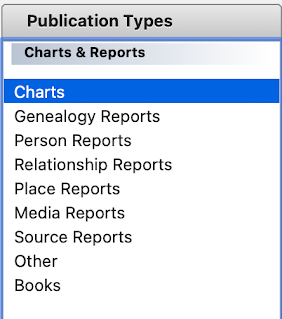
Family Tree Maker has many options that will generate charts or reports with the data I have already to saved to the program. At the top of my computer screen I click on "People" and find the individual I want and then Click on "Publish" and have the choices seen in this screen shot.


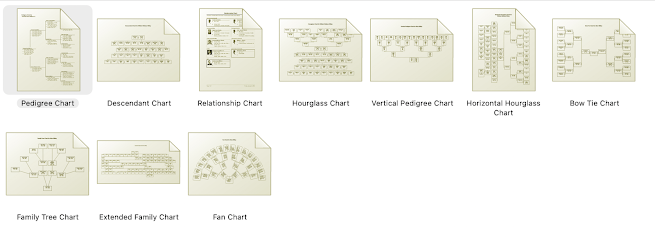
Publication. From these options I usually use "Charts." Then I have many options and I have used most of these charts over the years, depending upon what information I want to display and how much space I have for the chart to fit. The fan chart, for example, is large and if I add it to a blog post then details will be small. If I print it I will need large paper. 


Charts. Each chart can be adapted to your needs. You can decide how many generations of information you want to display. You can decide wha information you want to display for each person. Do you want to display the full birth and death details, day, month, year & location OR do you want to display just the range such as 1900 - 1990? Do you want to add marriage or burial details? You can adjust the chart to your needs.

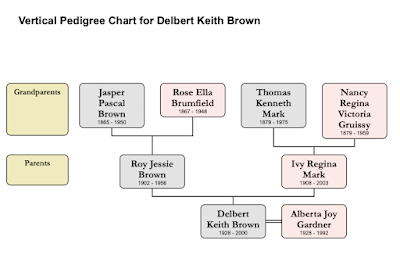
Vertical Pedigree Chart. For blog posts I use this chart the most often. I go to the "People View" and select the person who I am researching or blogging about. Then I go to the "Publish" tab, select the 'Vertical Pedigree Chart" and click on "Generate Report." A chart will appear and to the right of the chart with many chart options.

Options:
  • Items to include
  • Fonts (fonts, colors, sizes, alignments)
  • Box, Border & Line Styles (many options)
  • Inclusion of Images
  • Page Set up (for printing)
  • Margins (for printing)
These options are for any of the charts you chose. I suggest you play with these to find what you like. I have tried many of the options to find what I think will print or display clearly, with the information I want to share, in a manner that is easy for people who are not genealogists to understand. 


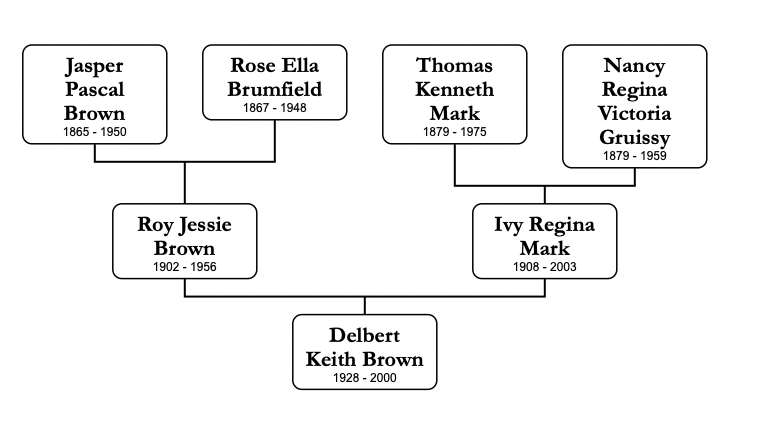
In the above chart I have changed colors in the boxes for males & females. I also have "Generation Boxes" on the left which are optional. The font can also be different for males, females, labels. In the chart below I omitted colors, Generation Boxes & the spouse of the primary individual. 


I could add the siblings of the primary individual & change each generation to a different color. I can change the shape & color of the primary individual's box. 


Do you want to add your sources for each fact in the chart? You can do that. Footnote numbers will show in each box and the list of source details will follow the chart. Do you want to add your name & address or blog name to the chart? You can do that. Do you want to add embellishments? You can do that too.

Keep your purpose in mind. Do you want to print the chart? Do you want to add it to a blog post? Is the result for a genealogist or someone who knows little about genealogy? Design the chart for your need. Play with the options. You can always delete the things that do not work for you. When you find a format that works you can save it in the program. You can go to your saved charts & formats to use again.

I hope this inspires you to use charts to share your research with others. 
Do you have a different program or app that you use?  
How do you use your charts? Please comment and share with us.


Friday, December 9, 2022

A Time to Write: 3. Edit, Edit, Edit!


OUR BROWN ROOTS

I am working on writing, Our Brown Roots, the history of my paternal grandfather’s family & its many leaves & branches. I am trying to focus my time & efforts on finishing up that huge project but will give some time to posting about the procedure here.


Here is an update on my progress with my book. I am very happy to have my first cousin, Nancy Jo (Brown) Dilley, helping me by editing this massive project. We have poured over every word, name, comma and quotation mark in the pages of this book. One chapter at a time, Nancy has read, edited and commented on our family's story. Then we met so we could look closely at each page.  We'd focus on every place her bright orange marker left a smiley face, a question mark, or note for me to address. My well read librarian cousin has given me very useful insights and comments. 

After years of researching and writing about the 13 family branches in this book, I needed a second pair of eyes. I need someone who is not a genealogist. Most of my eventual readers will not be genealogists so I need that point of view. Have I explained land grants, relationships and historical settings so they are understandable? Are my charts and maps confusing or clear?

Nancy would had me one chapter at a time to edit and then we would move on to the next. We worked our way through the over 800 pages!

I saved my Word document on a thumb drive and drove over to my local Staples. They printed 2 copies and returned them to me in two heavy boxes. We emptied our 2 inch binders and refilled them with this draft. What will we do now?

EDIT,  EDIT, EDIT!